Splitting costs fairly as a couple: do you really have to write everything down?
If you don’t want to put a strain on your relationship, it helps to be clear about things, and that goes double for money. Money is still one of the things couples argue about most. Sort it out early and you’ll save yourselves a lot of hassle and give your life together a solid footing. Sounds good so far, right?

Put it in writing to avoid nasty surprises
Why should couples who run a household together try to keep things financially balanced? Simple: being clear about money gives you legal security, especially if you’re not married. Marriage protects both partners if they divorce, but unmarried couples are on thin ice legally. In Germany, for example, an unmarried partner has no claim to a share of the other’s pension if things go wrong, and gets nothing if the other one dies. That’s not the only reason living together without being married needs clear rules. Verbal agreements are fine, written ones are better, because otherwise it’s easy to end up in a financial and personal mess. If you both signed the rental contract, for instance, each of you is on the hook for the rent, even if one of you moves out. And you don’t have to be talking about breaking up to see why clear money agreements make sense.
Shared finances: think about the risks too
Plenty of friendships have fallen apart over money, and relationships are no different. Even if it’s tempting and your partner doesn’t mind at first, try not to borrow money from them. If nothing is written down about who owes whom how much, it quickly leads to arguments and lasting resentment, and suddenly breaking up is on the table. With a joint loan, the payments still have to be made even if one of you can’t pay. And however much you love each other, don’t act as guarantor for each other’s debts. If your partner can’t pay, you’ll be the one paying.
A couple’s agreement: better safe than sorry!
You won’t always be able to avoid arguing about money in a relationship. What matters more is finding a way to make your relationship and your finances work together. Before you move in, you should agree on what happens to the things you buy together if you ever split up. A cohabitation agreement can save you a lot of arguments. For big joint purchases like furniture, a fridge or a washing machine, it’s worth putting the purchase down in a simple private agreement. If you have a joint bank account, you should both have authority over it. If you’re not married, each of you should keep your own bank account. Ideally you’d add a third one that you both pay the same amount into for shared purchases. If one partner doesn’t work, they need a fair amount of household money, enough to cover their retirement savings and the kids.
Splitting costs as a couple: which system makes sense?
The 50/50 split is a simple way to divide your costs evenly. If you both earn about the same, you can both put in the same amount. If one of you earns more, it should go without saying that they pay more into the joint bank account or the household budget. And if one of you is out of work for a while, they should still have a fixed amount of money to use, so they feel less dependent. A household budget book is ideal for keeping an eye on spending. When everything’s clearly laid out, there’s no room for vague, emotional guesses, and you skip a lot of pointless arguments.
Splitting expenses: Kittysplit does the maths for you
We built Kittysplit for exactly this kind of thing. It runs in your browser, so there’s nothing to download, and that makes it really easy for couples to keep track of their money.
Update 10.09.2025: Kittysplit is now also available as an app for Android and iOS. Here’s what’s new. The browser version still works without downloading anything.
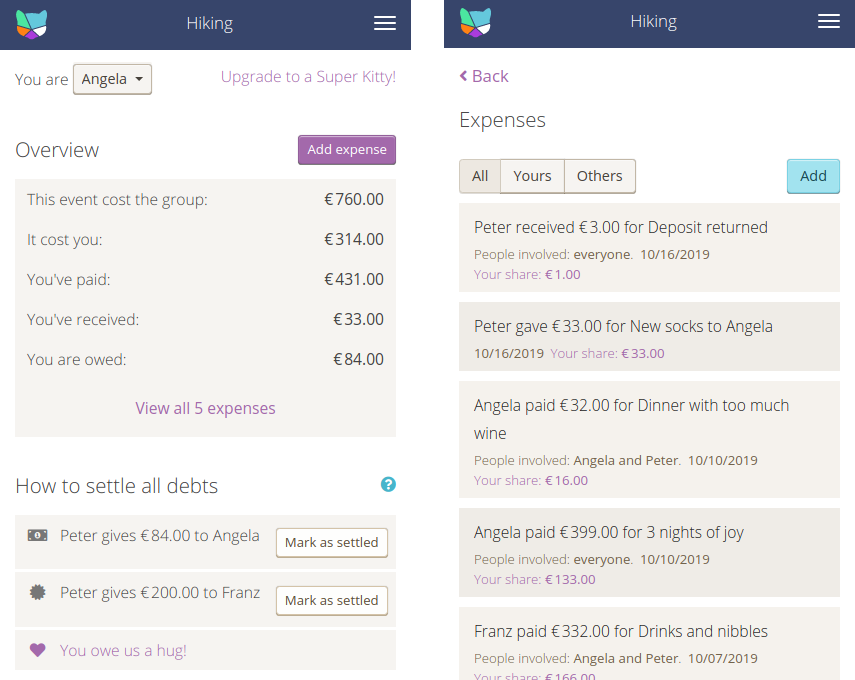
It’s easy to use, works on all the usual platforms and means you don’t need a joint household account. You can use it like a spreadsheet that you both have access to. Each of you enters your own expenses, sees what the other one has spent, and can share the details with whoever you like. And it’s not just for couples: on a holiday or for a party, friends can let each other know what they’ve paid and see right away who owes whom how much. Pretty handy!